
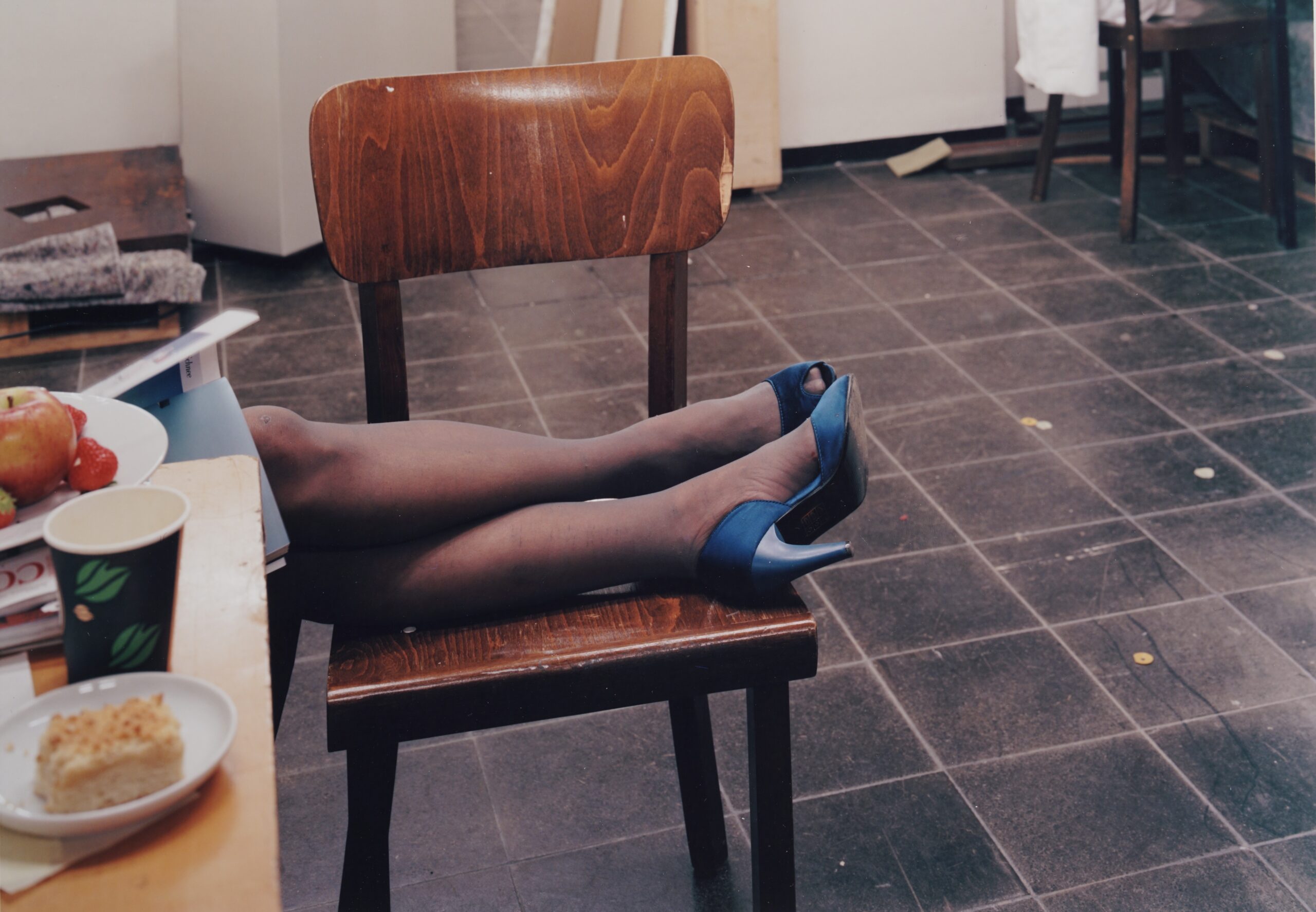
The good in the pot, the bad in the crop?
The exhibition “The good in the pot, the bad in the crop. The Storage | The Collection” opens the doors of Morsbroich’s art storage and questions the hierarchy within its own collection: the collection in the castle. The collection in the storage. The fairy tale of an art collection that never ages. The fairy tale of good and bad art, of representative flagship pieces and forgotten storage works, of progressive acquisition decisions and missed opportunities, of courageous attitudes and radical austerity, of visibility and invisibility.
In January 2025, the relocation of the museum’s art collection⸺built up since the 1950s⸺to an external art storage has started. The art moved out, leaving questions behind. Why are certain works from the collection repeatedly exhibited while others have been stored away for decades? Can we categorize art simply as good or bad, worth exhibiting or not? Are the “storage works” less relevant socially and art-historically or does the hierarchy within the collection follow a widespread but outdated art canon that also influences curatorial decisions?
Collecting art is one of the core tasks of a museum. The collection significantly contributes to the identity of an institution, forms the basis of its orientation, and exemplifies its attitude and values—at least in an ideal scenario. In reality, however, art collections, as with Morsbroich, are subject to an inevitable aging process due to a lack of acquisition budgets. Most of the art works are stored away, hidden in depots. Only selected pieces find their way into the public eye through permanent or temporary exhibitions.
This accompanying imbalance within the museum’s own collection is temporarily offset by the exhibition “the good in the pot, the bad in the crop. The Storage | The Collection.”. Works from the museum’s collection that have been stored away for many years are shown alongside works that are frequently exhibited, intending to make visible what was not visible⸺and what is not visible. Every present becomes historical at some point, along with outdated norms, values, and ideals. In 2026, Museum Morsbroich will celebrate its 75th anniversary. Time to look back and time to look forward. What was, what is – and what could be. Future Fiction.
With works by
Rimma Arslanov, Joachim Bandau, Stojan Batič,
Laurenz Berges, Joseph Beuys,
Hans-Joachim Bleckert, Julius Bretz,
Ursula Burghardt, Hal Busse, Cihan Çakmak,
Jože Cihua, Jun Dobashi, Günter Drebusch,
Mic Enneper, Robert Filliou, Helga Föhl,
Lucio Fontana, Tsuguharu Foujita,
Xaver Fuhr, Ernst Geitlinger, Isa Genzken,
Ludwig Gies, Raimund Girke,
Gerhard von Graevenitz, Vera Haller,
Barbara Hepworth, Peter Herkenrath,
Jochen Hiltmann, Karl Hofer, Ward Jackson,
Ed Kiёnder, Yves Klein, Norbert Kricke,
Eric Lanz, Karolus Lodenkämper, Adolf Luther,
Michel Majerus, Jonathan Monk,
François Morellet, Naondo Nakamura,
Louise Nevelson, Bruno Pelz, Otto Piene,
Norbert Prangenberg, Judit Reigl,
Günter Ferdinand Ris, Dieter Roth,
Alexej von Jawlensky, Gerhard Richter,
Oskar Schlemmer, Christa von Schnitzler,
Johannes Schreiter, Bernard Schultze,
Pia Stadtbäumer, Markus Sixay, Takis,
Yasse Tabuchi, Günther Uecker,
Ben Vautier, Wolf Vostell, Ursula (Schultze-Bluhm),
Günter Weseler, Xiang Xiaoli
Curated by Thekla Zell